A sonic exploration and tonal analysis of contemporary creative music in a myriad of improvisational/composed settings, textures, and expressions.
Welcome to Sound Projections
I'm your host Kofi Natambu. This online magazine features the very best in contemporary creative music in this creative timezone NOW (the one we're living in) as well as that of the historical past. The purpose is to openly explore, examine, investigate, reflect on, studiously critique, and take opulent pleasure in the sonic and aural dimensions of human experience known and identified to us as MUSIC. I'm also interested in critically examining the wide range of ideas and opinions that govern our commodified notions of the production, consumption, marketing, and commercial exchange of organized sound(s) which largely define and thereby (over)determine our present relationships to music in the general political economy and culture.
Thus this magazine will strive to critically question and go beyond the conventional imposed notions
and categories of what constitutes the generic and stylistic definitions of ‘Jazz’, ‘classical music’, ‘Blues.’
'Rhythm and Blues’, ‘Rock and Roll’, ‘Pop’, ‘Funk’, ‘Hip Hop’, etc. in order to search for what individual
artists and ensembles do creatively to challenge and transform our ingrained ideas and attitudes of what
music is and could be.
So please join me in this ongoing visceral, investigative, and cerebral quest to explore, enjoy, and pay
homage to the endlessly creative and uniquely magisterial dimensions of MUSIC in all of its guises and expressive identities.
AS
OF JANUARY 13, 2023 FIVE HUNDRED MUSICAL ARTISTS HAVE BEEN FEATURED IN
THE SOUND PROJECTIONS MAGAZINE THAT BEGAN ITS ONLINE PUBLICATION ON
NOVEMBER 1, 2014.
THE
500th AND FINAL MUSICAL ARTIST ENTRY IN THIS NOW COMPLETED EIGHT YEAR
SERIES WAS POSTED ON THIS SITE ON SATURDAY, JANUARY 7, 2023.
BEGINNING JANUARY 14, 2023 THIS SITE WILL CONTINUE TO
FUNCTION
AS AN ONGOING PUBLIC ARCHIVE AND SCHOLARLY RESEARCH AND REFERENCE
RESOURCE
FOR THOSE WHO ARE INTERESTED IN PURSUING THEIR LOVE OF AND INTEREST IN
WHAT THE VARIOUS MUSICAL ARTISTS ON THIS SITE PROVIDES IN TERMS OF
BACKGROUND INFORMATION AND VARIOUS CRITICAL ANALYSES AND COMMENTARY
OFFERED ON BEHALF OF
EACH ARTIST ENTRY SINCE NOVEMBER 1, 2014.
ACCESS TO EACH ARTIST CAN BE FOUND ON THE RIGHT SIDE OF THE HOME PAGE WHERE THE 'BLOG ARCHIVE' (ARTISTS LISTED IN WEEKLY CHRONOLOGICAL ORDER) AND ‘LABELS' (ARTIST NAMES, TOPICS, ETC.) LINKS ARE LOCATED. CLICK ON THESE RESPECTIVE LINKS TO ACCESS THEIR CONTENT:
ART ENSEMBLE OF CHICAGO (1967-Present): Legendary iconic, and innovative quintet of musicians, composers, arrangers, bandleaders, music theorists, philosophers, and teachers
Theme De Yoyo
(Music & Lyrics by the Art Ensemble of Chicago--the singer is FONTELLA BASS)
Your head is like a yoyo your neck is like a string Your body's like camembert oozing from its skin.
Your fanny's like two sperm whales floating down the Seine Your voice is like a long fork that's music to your brain.
Your eyes are two blind eagles that kill what they can't see Your hands are like two shovels digging in me.
And your love is like an oil-well Dig, dig, dig, dig it, On the Champs-Elysees.
Art Ensemble Of Chicago – Message To Our Folks [Full Album] 1969
Recorded August 12, 1969, Studio Saravah, Paris France
The Art Ensemble of Chicago: Long Live Great Black Music!
by Kofi Natambu
September 12, 1984
Detroit Metro Times
One of the more absurd comments made about contemporary black creative music of late is a ridiculous assertion made by someone who should know better, a certain Mr. Wynton Marsalis—trumpet wunderkind and current Jazz celebrity darling. In an astounding statement even for the usually outspoken and highly opinionated 22-year-old, Marsalis says in the July, 1984 edition of Downbeat magazine that “nothing got established in the Jazz tradition in the 1970s.” This is such an outlandishly false statement on the given evidence that it almost doesn’t deserve a reply. But we can’t simply allow such an obviously silly and inaccurate remark to slide by without a severe challenge, even if it was made by an overzealous young media “star.”
C’mon Wynton, Give-us-a-break brother! You mean to tell me that you never heard of the Art Ensemble of Chicago? It’s sad, but true, that unfortunately there are still too many musicians who out of ignorance, pettiness or bias try to deny that necessary and often profound changes are taking place. Of course no one says that Marsalis or anyone else has “to like it” but please, a little credit where credit is due!
Speaking of credit, let’s all take a few precious moments to humbly acknowledge and thank Ptah (the God who protects and nurtures the Artist) that we have the Art Ensemble of Chicago. Talk about IRONY. Where else but in American music would one find five black virtuoso musician-composers who between them have mastered over one hundred instruments, including nearly every single member of the reed and woodwind families, as well as trumpet, bugle, and a bewildering array of percussion, string, and traditional acoustic instruments from various ethnic cultures around the world? The AEC is a virtual sonic encyclopedia of forms, styles, and traditions in the long history of African-American, and other world musics. After all, we are talking about the very best contemporary representatives of that endlessly creative tradition called “Jazz” though it should be stated up front that the AEC is much too dynamic, versatile, and broad-minded in concept and method to be easily fitted into any single category of musical expression.
It is equally important to realize that despite expressing a very wide spectrum of musical tastes and interests that range from the blues to swing, ragtime, ballads, spirituals, bebop, rock ‘n roll, ancestral folk songs, and various so-called “avant-garde” and ethnic musics, the Art Ensemble is not merely an eccentric band of eclectics. There is always at the core of their musical performances an utterly independent and quite original vision of what the AEC has always simply called “Great Black Music.” It is this boundless visionary spirit, and a stunning extension and subtle re-evaluation of the totality of ‘western’ and ‘eastern’ music (and by artistic implication, their cultural philosophies) that characterizes the AEC and makes them, in my view, the most important musical ensemble to emerge in the U.S. since the John Coltrane and Ornette Coleman Quartets put everyone on notice some 25 years ago.
It is necessary then to ask two rather obvious questions: Where did such a band come from, and who are these guys anyway? For an answer to both questions you have to start in Chicago. It was there that four of these five dapper young men met and played together. It began as early as 1961 when the pianist-composer Muhal Richard Abrams put together the Experimental Band, a workshop and rehearsal outlet for young innovative musician-composers. It was also in this big band that the great Roscoe Mitchell met and began to collaborate with another extraordinary multi-instrumentalist and composer, Joseph Jarman. It was in this ensemble that Mitchell first met and worked with one of the finest bassists in the world, the regal Malachi Favors Maghostut.
It was also in Shytown in March, 1965, that a visionary group of black creative musicians led by young veteran musician-composers Muhal Richard Abrams, Jodie Christian, Steve McCall, and Phil Cohran organized the now world famous musicians’ collective known as the Association for the Advancement of Creative Musicians (AACM). It was in this nurturing context of on-going creative activity that the wise and whimsical Mr. Lester Bowie, trumpet master and composer joined the then Roscoe Mitchell Art Ensemble in 1966, after arriving from St. Louis. It was this group (Mitchell, Favors, and Bowie, along with drummer Phillip Wilson) that first began to gain considerable attention in improvisational music circles. In 1966 Mitchell’s group, augmented with other outstanding young musicians from the AACM record Sound for the local based label, Delmark Records. This record quickly became a cherished collector’s item and is a landmark in the development of ‘new music’ worldwide.
In l968 Joseph Jarman, who had been leading his own highly innovative groups, joined with Mitchell, Favors, and Bowie to officially form the first edition of the Art Ensemble of Chicago. It was this group that gained legendary status by leaving the U.S. for France in 1969, where they remained for two years recording some fifteen albums while also composing music for three films and touring throughout Europe. It was during this whirlwind tour that they met the outstanding drummer/composer Famoudou Don Moye who had been playing with the Detroit Free Jazz ensemble in Italy. Moye joined the band permanently in 1970.
The Art Ensemble features incredible versatility along with dazzling theatrics, a high sense of drama and great wit and humor, not to mention lyrical and explosive poetry and a dadaist sense of reality. Don’t walk, RUN to the Detroit Institute of Arts, Wednesday, September 19 at 8p.m. You will hear one of the true wonders in all of music today.
The Art Ensemble Of Chicago (LIVE sometime during the late'70s, early '80s)
Art Ensemble of Chicago - Châteauvallon 1970
France
FOR THE ART ENSEMBLE OF CHICAGO by Kofi Natambu
These
painters of luminous landscapes their canvas a soaring sound in steel
blue and flowing reds the royal song a floating majesty its black and
golden robes marching toward the light.
It is the new day they sing to the new way they cling to the freshpaint they spray thru our secure but rotting walls
Spatial
muralists with electron brushes swift proton strokes crystal neutron
rhythms they fill the gaping atomic holes in our souls
A Jackson in Your House was recorded while the Art Ensemble was on its initial sojourn in Paris with just a quartet -- Roscoe Mitchell, Lester Bowie, Malachi Favors, and Joseph Jarman -- because drummer Phillip Wilson had left to play with Muhal Richard Abrams and Foumoudou Don Moye wasn't in the house yet. So this, along with its companion LP, A Message to Our Folks, showcases the Art Ensemble at its bravest and most vulnerable. For those familiar with the earlier recordings on Nessa, such as People in Sorrow, A Jackson in Your House is shockingly formalist, though far from conventional in any way. Here the band was interested in being a gigging and recording "art ensemble" more than being a free jazz group. Hence, all sorts of theatrical elements are involved in the performances. The set opens with the title track, which sounds like a rent party with music playing both on the juke and in the living room. Given that this was 1969, a number of jazz critics misunderstood the New Orleans references in the music and took this to mean that the band had either sold out its experimental heritage (which is absurd), or they were poking fun at the founding fathers of the music known as jazz (which is absurd, too). If anything, by utilizing on the opening statement -- and indeed throughout the album -- the historical frames of jazz, the Art Ensemble revealed its deep empathy with Armstrong, W.C. Handy, King Oliver, Jelly Roll Morton, etc. The freewheeling influence of Ornette Coleman is felt on "Get in Line," with its strident pacing, stop-on-a-dime changes, and stretched melodic and harmonic sensibilities -- check out Favors trying to keep the saxophones "lined up" in the middle of the tune since he's the only rhythm player. There are some things that don't translate well to a recording session, however, and the largely spoken theater of "Old Time Religion" is one of them. Near the end of the disc, on "Rock Out," the band proves it can funk and rock with the best and worst of them by using an electric guitar and a host of percussion instruments, taking a riff apart endlessly until it becomes just some funky detritus in the mix. A Jackson in Your House is not the finest or most revelatory recording by the Art Ensemble of Chicago, but it is one of their more entertaining and carefree outings and, as expected, the French ate it up.
AS
OF JANUARY 13, 2023 FIVE HUNDRED MUSICAL ARTISTS HAVE BEEN FEATURED IN
THE SOUND PROJECTIONS MAGAZINE THAT BEGAN ITS ONLINE PUBLICATION ON
NOVEMBER 1, 2014.
THE
500th AND FINAL MUSICAL ARTIST ENTRY IN THIS NOW COMPLETED EIGHT YEAR
SERIES WAS POSTED ON THIS SITE ON SATURDAY, JANUARY 7, 2023.
BEGINNING JANUARY 14, 2023 THIS SITE WILL CONTINUE TO
FUNCTION
AS AN ONGOING PUBLIC ARCHIVE AND SCHOLARLY RESEARCH AND REFERENCE
RESOURCE
FOR THOSE WHO ARE INTERESTED IN PURSUING THEIR LOVE OF AND INTEREST IN
WHAT THE VARIOUS MUSICAL ARTISTS ON THIS SITE PROVIDES IN TERMS OF
BACKGROUND INFORMATION AND VARIOUS CRITICAL ANALYSES AND COMMENTARY
OFFERED ON BEHALF OF
EACH ARTIST ENTRY SINCE NOVEMBER 1, 2014.
ACCESS TO EACH ARTIST CAN BE FOUND HERE, WHERE YOU CAN FIND THE 'BLOG ARCHIVE' (ARTISTS LISTED IN WEEKLY CHRONOLOGICAL ORDER) AND ‘LABELS' (ARTIST NAMES, TOPICS, ETC.) ON THE RIGHT SIDE OF THE HOME PAGE. CLICK ON THESE RESPECTIVE LINKS TO ACCESS THEIR CONTENT:
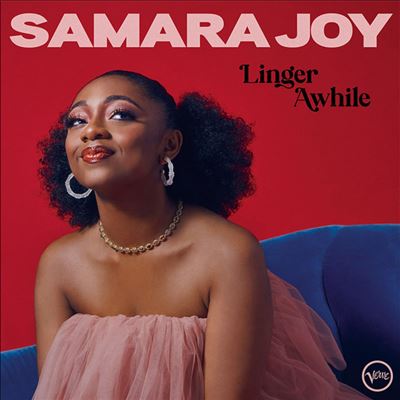
Samara Joy is an American jazz singer from New York City. Her smooth, luscious, velvety style and throaty alto reflect the golden era of interpretive genre vocalists from the 1930s through the mid-'60s including Ella Fitzgerald, Sarah Vaughan, and Billie Holiday. Her repertoire is comprised mainly of vintage jazz and pop standards. Her eponymous debut album appeared on the London-based indie Whirlwind Recordings in 2021 when she was 21. Backed by guitarist Pasquale Grasso, drummer Kenny Washington, and bassist Ari Roland, the set was highly acclaimed. After festival and touring appearances, she guested on recordings by the Bruce Harris Quartet and Grasso. She signed to Verve for 2022's Linger Awhile, and along with Grasso and Washington, it featured David Wong in the bass chair and pianist Ben Paterson. The album won Joy two Grammy Awards, including Best New Artist.
Joy was first introduced to jazz while attending Fordham High School for the Arts, where she performed regularly with the jazz band and eventually won Best Vocalist at an Essentially Ellington Competition. After hearing Sarah Vaughan's version of "Lover Man," she enrolled in a jazz studies program at SUNY Purchase and won the Sarah Vaughan International Jazz Vocal Competition in 2019. It earned her a tuition-free scholarship from the Ella Fitzgerald Foundation. She graduated with degrees in jazz composition and arrangement.
To thank the institution, Pete Malinverni, head of jazz studies at SUNY Purchase, asked Joy to film a Fitzgerald song with him playing piano. The two cut their parts separately and the performances were combined on a reading of "Take Love Easy." The video went viral. Buoyed by encouragement from producer Matt Pierson she undertook a Go Fund Me campaign and raised enough money to record her eponymous debut album in a matter of days.
With Pierson producing, she enlisted guitarist Pasquale Grasso's trio (all affiliated with SUNY Purchase), drummer Kenny Washington, and bassist Ari Roland to cut her self-titled debut for Whirlwind Recordings; it came out in July 2021. Composed entirely of standards, it won global accolades and she was rewarded with gigs throughout Manhattan's jazz club scene and a concert performance at that year's Newport Jazz Festival with Grasso, Washington, pianist Ben Paterson, and bassist David Wong.
She signed with Verve and recruited the same crew of musicians and Pierson to record her label debut. She appeared on "I'm a Mess," the first single off Grasso's charting Be-Bop in June 2022, and issued her own Linger Awhile in September. The release was named Best Jazz Vocal Album at the 65th Annual Grammy Awards in 2023. More importantly, Joy won the coveted Best New Artist award.
With a voice as smooth as velvet, SAMARA JOY’s star seems to rise with each performance. Following her winning the 2019 Sarah Vaughan International Jazz Vocal Competition, she is currently recording her debut recording, which will feature Samara backed by the Pasquale Grasso Trio.
Growing up in New York, music was a pervasive presence, due to the inspiration of her paternal grandparents, Elder Goldwire and Ruth McLendon, who led the well-known Philadelphia-based gospel group, The Savettes. Her father toured with the renowned Gospel artist Andrae Crouch, and her home was filled with the sounds of not only her father’s songs and songwriting process, but the inspiration of many Gospel and R&B artists, including Stevie Wonder, Lalah Hathaway, George Duke, Musiq Soulchild, Kim Burrell, Commissioned, and many others.
“Although I didn’t grow up singing in church,” explains Samara, “I constantly heard my family singing inspirational music together, which instilled in me an appreciation for my musical lineage. Through musicals in middle school, I loved exploring the range of my voice and applying the different colors to fit the characters I played. Finally, during high school, I joined the choir at my church, eventually becoming a worship leader, singing three services a week for nearly two years. That was my training.”
Samara’s first exposure to jazz was while attending Fordham High School for the Arts, where she performed regularly with the jazz band, eventually winning Best Vocalist at JALC’s Essentially Ellington competition. However, jazz wasn’t really her focus until the time came to choose a college. Wanting to attend a state school close to home, she picked SUNY Purchase, gaining acceptance into their acclaimed jazz program, with a faculty that includes many jazz masters (including Pasquale Grasso and drummer Kenny Washington, who both appear on her debut recording.)
“My friends were all into jazz and started sharing their favorite recordings with me to check out. The turning point was when I heard both Sarah Vaughan’s version of ‘Lover Man’ and Tadd Dameron’s recordings featuring trumpeter Fats Navarro. I was hooked.”
From this point, she began to pursue her jazz studies with an intense passion, eventually being named the Ella Fitzgerald Scholar and entering and winning the Sarah Vaughan International Jazz Vocal Competition.
Not yet 21 years old, Samara has already performed in many of the great jazz venues in NYC, including Dizzy’s Club Coca Cola, The Blue Note, and Mezzrow, in addition to working with jazz greats such as Christian McBride, Pasquale Grasso, Kirk Lightsey, Cyrus Chestnut, and NEA Jazz Master Dr. Barry Harris.
As she begins work on her debut recording (to be released in the spring of 2021), Samara Joy looks forward to sharing her passionate love for jazz as a uniting force in the years to come.
"I love listening to the music. I love singing the songs."
—Samara Joy
When Samara Joy performs, she takes her place, stands confidently and sings. Immediately the strength and richness of her voice—which is natural—grabs the attention of the listener. There are no gyrations. It's refreshing that a young artist doesn't see the need for unnecessary vocal gymnastics. Too often, those can miss the mark.
Her style has a certain clarity and directness of emotion. She's only 21 and graduated just this May from SUNY Purchase, a state college north of New York City and her native Brooklyn. She has a degree in jazz studies. But before attending college, she had little performing experience and not much knowledge of her chosen genre: jazz. It makes her accomplishment all the more remarkable.
She won the prestigious Sarah Vaughan International Jazz Vocal Competition in 2019, which will earn her a spot on stage at the Newport Jazz Festival in August. Another example of her artistry at such a young age is a video she made after being named an Ella Fitzgerald Scholar at her school, which earned her a tuition-free scholarship from the Ella Fitzgerald Foundation. To thank the foundation, Pete Malinverni, head of jazz studies, asked her to record a Fitzgerald song with him. The two filmed their parts separately and the performances were combined on a video that went viral. The "Take Love Easy" video attracted an immense audience.
Buoyed by that unexpected reaction, she launched a GoFundMe campaign to finance her first album Samara Joy that comes out in July via Whirlwind Recordings.
She is humble and unassuming about her accomplishments and admits that as a young girl, "I was actually a quiet kid. My mom was kind of nervous about me, because all I would do is just stare people down. Turns out I was waiting for something to say."
"I couldn't even believe it," she says of the reaction to her video. "Millions of people viewed it and cheered and everything. And from there, Matt Pierson (producer) reached out to me and was like, 'Hey, you know there seems to be sort of a demand to hear from you.' I don't have any music, nothing on Spotify or anything like that. So once we raised the money in a matter of days, that began the whole process ... I guess it turned out all right."
She says she inadvertently benefited, in a sense, from the pandemic, which delayed her Newport appearance, and some others, by a year. "Being delayed on those gigs was a good thing. Because I have something to present now" at her appearances. She will do more performances as venues start to have live music this year.
Sarah Vaughan is a prime influence for the young singer, as is Fitzgerald. That can be clearly heard on her debut recording. Her voice is deep and full of expression, nuanced where necessary. It is a presentation of standards including "Stardust," "Everything Happens to Me," "Lover Man," "Jim," and "But Beautiful." She's accompanied by a trio consisting of guitarist Pasquale Grasso, bassist Ari Roland and renowned drummer Kenny Washington. Grasso and Washington teach at SUNY Purchase. She digs in for some sweet swing on renditions of "Everything Happens to Me" and "The Trouble With Me is You" where her timing is great. Her phrasing gets a lot out of the lyric. She handles the tricking melody and harmony of "Jim" beautifully—a highlight—and squeezes the right emotion out of ballads like "But Beautiful."
It was recorded at the end of October of 2020. She knew Washington from being a student in his jazz history class. Grasso and Roland she met at the nightclub Mezzrow in New York, "so I was really grateful to be sort of familiar with all of them prior to doing this. Because I had a couple people in my ear saying you should go higher, you know. Play with Kenny Barron or something. And I would obviously love to, but I definitely didn't have the budget at the time. But I'm really grateful to play with people that I know and am comfortable with at first."
Samara selected the songs with Pierson. "All of those songs are songs that I've listened to or heard from a friend and you know, learned from listening to a record or something like that. So all of those songs are really very special to me," she says. "We only had three rehearsals. So it was sort of like putting together the arrangements kind of on the spot. By the time we got into the studio, it was simple, but still, you know, clean."
While she's relatively new to jazz, the soulfulness in her voice can be traced to her family of musicians. Her grandmother played organ and sang and her grandfather sings as well. They both were founders of a choir in Philadelphia called the Savettes. "They're not the leaders anymore, but still active to this day. And it just kind of trickles down from there. So their kids—my father is a bassist and sings, my aunts sing and play piano. Everybody sings."
Around the house, she listened to a lot of music written by her song-writing father, as well as gospel music. There was some pop music, "Whatever was on the radio on the way home. But it's funny. Throughout high school, my uncle gave me this iPod, one of those really old ones, and it had all of music he liked on there, like the Yellowjackets and George Duke. I think Russell Malone might have been on there. Chick Corea. I would just press shuffle on my way. When I started taking the bus by myself, I would press shuffle on the way home and just listen to everything that came up. ... Not too much popular music. I just listened to what my my family listened to."
Samara's first exposure to jazz was while attending Fordham High School for the Arts, where she performed with the jazz band and won Best Vocalist at the Essential Ellington competition put on by Jazz at Lincoln Center's Jazz Academy, a program for high school bands.
"My last two years of high school, I joined the after-school jazz band. We would perform whenever there was a big production at school. There was vocal, there was acting, there was dance. So the instrumental section, I would kind of sit in with the band. I was just singing with the jazz band, very casually, occasionally.”
Sarah Vaughan is a prime influence for the young singer, as is Fitzgerald. That can be clearly heard on her debut recording. Her voice is deep and full of expression, nuanced where necessary. It is a presentation of standards including "Stardust," "Everything Happens to Me," "Lover Man," "Jim," and "But Beautiful." She's accompanied by a trio consisting of guitarist Pasquale Grasso, bassist Ari Roland and renowned drummer Kenny Washington. Grasso and Washington teach at SUNY Purchase. She digs in for some sweet swing on renditions of "Everything Happens to Me" and "The Trouble With Me is You" where her timing is great. Her phrasing gets a lot out of the lyric. She handles the tricking melody and harmony of "Jim" beautifully—a highlight—and squeezes the right emotion out of ballads like "But Beautiful."
It was recorded at the end of October of 2020. She knew Washington from being a student in his jazz history class. Grasso and Roland she met at the nightclub Mezzrow in New York, "so I was really grateful to be sort of familiar with all of them prior to doing this. Because I had a couple people in my ear saying you should go higher, you know. Play with Kenny Barron or something. And I would obviously love to, but I definitely didn't have the budget at the time. But I'm really grateful to play with people that I know and am comfortable with at first."
Samara selected the songs with Pierson. "All of those songs are songs that I've listened to or heard from a friend and you know, learned from listening to a record or something like that. So all of those songs are really very special to me," she says. "We only had three rehearsals. So it was sort of like putting together the arrangements kind of on the spot. By the time we got into the studio, it was simple, but still, you know, clean."
While she's relatively new to jazz, the soulfulness in her voice can be traced to her family of musicians. Her grandmother played organ and sang and her grandfather sings as well. They both were founders of a choir in Philadelphia called the Savettes. "They're not the leaders anymore, but still active to this day. And it just kind of trickles down from there. So their kids—my father is a bassist and sings, my aunts sing and play piano. Everybody sings."
Around the house, she listened to a lot of music written by her song-writing father, as well as gospel music. There was some pop music, "Whatever was on the radio on the way home. But it's funny. Throughout high school, my uncle gave me this iPod, one of those really old ones, and it had all of music he liked on there, like the Yellowjackets and George Duke. I think Russell Malone might have been on there. Chick Corea. I would just press shuffle on my way. When I started taking the bus by myself, I would press shuffle on the way home and just listen to everything that came up. ... Not too much popular music. I just listened to what my my family listened to."
Samara's first exposure to jazz was while attending Fordham High School for the Arts, where she performed with the jazz band and won Best Vocalist at the Essential Ellington competition put on by Jazz at Lincoln Center's Jazz Academy, a program for high school bands.
"My last two years of high school, I joined the after-school jazz band. We would perform whenever there was a big production at school. There was vocal, there was acting, there was dance. So the instrumental section, I would kind of sit in with the band. I was just singing with the jazz band, very casually, occasionally.”
PHOTO: A few years after winning a prestigious jazz vocal
competition while still a college student, 23-year-old Samara Joy is now
a multiple Grammy nominee for her album Linger Awhile. Meredith Truax/Courtesy of the artist
Samara Joy stood gently swaying, within a rare circle of calm late
last year, as a Hammond organ purred in sanctified accord. It was four
days before Christmas. Joy was at Ardmore Music Hall just outside of
Philadelphia, preparing to sing "O Holy Night," which she'd released as a holiday single with The McLendon Family — her
family, who was with her onstage. Joy took a deep breath and started
into the hymn, her voice centered in a contralto register, exuding
understated warmth and composure. It was only later in the song, when
she sang "a night di-vine" — punching up the last syllable to a
climactic E-flat, which she held for six long seconds before the vocal
equivalent of a barrel roll — that Joy showed any sign of exertion, or
the glittery star power she'd accrued. The turn in that moment was a
reminder that for all her persuasive ease as an ingénue, she's acutely
aware of her charisma, and how to wield control.
One month
earlier, several days after Joy celebrated her 23rd birthday, she'd been
named a nominee in two categories at the 65th Grammy Awards: best jazz
vocal album, for her strong sophomore effort on Verve, Linger Awhile;
and more surprisingly, best new artist, alongside the likes of Atlanta
rapper Latto, Latin pop singer Anitta and Nashville troubadour Molly
Tuttle. Joy was on a train from Washington D.C. to New York when she got
the news — "but I had to keep quiet, 'cause I was in the quiet car,"
she later said, on The Jennifer Hudson Show. Arriving at Penn Station, she was greeted by her sister, who filmed her uncorked reaction to the nominations; a jubilant clip on Joy's TikTok has, at last count, racked up almost 4 million views.
What has come since for Joy is a high-wire act, a teetering
balance of prior obligations and new opportunities. In early December,
she was on the road for Big Band Holidays, an annual tradition of the
Jazz at Lincoln Center Orchestra with Wynton Marsalis, when she got an
invitation to sing the national anthem at a New York Giants game. So
after a concert in York, Pa., she got on a bus, making it to MetLife
stadium in time to perform "The Star-Spangled Banner"
for 80,000 NFL fans — and then hustled back to the tour. When Big Band
Holidays returned to New York for several nights at Jazz at Lincoln
Center, Joy kicked into multitask mode, dropping her seasonal singles,
engaging in a blizzard of promotional activity, and performing on The Kelly Clarkson Show and The Late Show with Stephen Colbert. As Lara Downes recently put it on the NPR series Amplify:
"All of a sudden, Samara Joy was everywhere." It's no wonder that, in
order to spend the holidays with family, her best option was to bring
them onstage.
Awards-season campaigning is more of an Oscars
thing, but Joy's cheerful ubiquity, and the unforced glow of her
ability, have conspired to make her perhaps the closest thing to a
frontrunner in this year's best new artist race. Which is remarkable,
given that Samara Joy sings jazz and songbook standards in a
straight-ahead style that was last broadly popular in the 1950s and
early '60s. Unlike late 20th-century platinum torchbearers Harry Connick Jr. and Diana Krall,
she's finding mainstream success at a moment of extreme atomization in
the music business, let alone pop culture at large. So her breakout
moment comes with an inevitable burden of accountability for the art
form.
"I feel it, and I understand it," Joy says about that weight on
her shoulders, speaking recently from her apartment in Upper Manhattan's
Washington Heights neighborhood. Name-checking some influences,
starting with Betty Carter and Sarah Vaughan, she points out that those
affinities come with a natural point of departure. "I couldn't do this
without that foundation that they've laid," she says. "But I am 23, and
I'm singing jazz in 2023, and I come from a different background than
all of those artists. So I think that carrying on the tradition is
progressing as you grow, and not being in a singular box."
Before
the show at Ardmore Music Hall, I ran into Matt Pierson, a record
industry veteran who produced both of Joy's albums, and signed on as her
manager. (He stood behind a merch table, checking his phone.) Marveling
at the ride Joy was on, Pierson was quick to give her all the credit;
he's fond of calling her a "once-in-a-generation talent," a phrase that
has figured prominently in her publicity materials. But he mentioned
something else that felt like a key to understanding Joy's spectacular
rise: how her audience parses into three distinct segments, which all
converged to propel her to this point in her career. It was a
recognition that, rather than be one thing to all people, Joy could be certain things to certain
people, in different ways. Watching her evolve over the last several
years, this made perfect sense to me, not as a commercial calculation
but rather a savvy acknowledgment of her background, her talent and her
temperament, along with a nod toward the artist she's determined to
become.
Jazz fans: That's the
first, thuddingly obvious audience segment in Joy's portfolio. Pierson
knows the type well. He understands how much enthusiasm jazz listeners
can shower on a bright young newcomer — provided the baseline
requirements are met. Jazz fans don't just fall in line; they've seen
enough hype and hustle to grow a little wary with their trust.
So
it's worth restating one of the more startling talking points around
Samara Joy: She's only been singing jazz for the last five years. After
dipping a toe into the tradition at Fordham High School for the Arts,
she received a full baptism at Purchase College, whose Jazz Studies
faculty includes noted players like trumpeter Jon Faddis and drummer
Kenny Washington. "Everybody was really supportive, but I still had this
feeling like, 'I don't know if I belong,' " Joy now recalls. "Because I
didn't have this preconceived notion of what it's supposed to sound
like. But as it turns out, that allowed me to be a sponge and just soak
everything in."
Her father, Antonio McLendon, is a singer and
bassist who toured for years with gospel star Andraé Crouch, extending
the legacy of his parents — Elder Goldwire and Ruth McLendon,
who sang in the lauded Philadelphia group The Savettes. (A highlight of
the Ardmore Music Hall show was a cameo by Elder Goldwire McLendon, who
is 92.) While this was the tradition into which Samara was born, Antonio
didn't balk at her musical pivot. "When she came into contact with
jazz, she immediately developed a respect for it," he says. "I've
watched her study for hours, puzzling over things: 'How does Ella
Fitzgerald scat like that?' I would hear her in the middle of the night
practicing horn lines, because she learned that's something Ella would
do."
Samara Joy performs in April 2022, at the Jazz At
Lincoln Center Gala event Body + Soul: America Rises Through the Arts.
Noam Galai/Getty Images for Jazz At Lincoln Center
She was 19, still known as Samara McLendon, when I first heard her
with the Purchase College Songbook Ensemble in 2019, singing "A
Sailboat in the Moonlight." Later that year, as a contestant in the
Sarah Vaughan International Jazz Competition, she sat for her first radio interview,
with Keanna Faircloth, then a host at WBGO. Faircloth recalls
witnessing a miraculous transformation: "She came into the studio meek
and mild, almost like a deer in the headlights, and she walked out onto
that stage in this royal purple velvet dress, in full command. I
couldn't even believe this was the same girl. It was like she took on a
totally different persona."
McLendon won first place, and at
20, suddenly found herself in the spotlight's glare. "As brilliant as
some of the other singers were, it was very clear to me that she was the
one," says Pierson, who served on the judges' panel. The realization
excited and worried him. "Normally with an artist this age, coming out
of college," he reflects, "you'd have a couple of years of growth,
developing your career, playing in other people's bands, and finding
opportunities to work with potential mentors and masters. So to me the
challenge is, as things move so quickly, how do you make sure you still
facilitate those developmental processes?"
Pierson was an A&R executive at Warner Bros. in 1991, when saxophonist Joshua Redman
won the Thelonious Monk International Jazz Competition and set off a
major-label bidding war. After signing to Warner, Redman went on to make
a slew of acclaimed albums produced by Pierson; so did a few of his
peers, like pianist Brad Mehldau.
Their generation caught the tail end of a cultural moment primed for
youthful jazz talent, traveling a path forged by Wynton Marsalis — but
also diverging from it, with forays into rock, funk and soul. Still,
their evident proficiency and potential sent a reassuring message in
jazz circles: The music had a bright future.
Instinctively, Pierson knew Samara McLendon could strike a similar chord. They started talking, and he eventually produced Samara Joy,
recorded late in 2020 and released the following year on Whirlwind
Recordings, a well-regarded independent label. Featuring a trio led by
the Italian guitar virtuoso Pasquale Grasso, whom Pierson had signed to
Sony Masterworks, it's a springy and elegant first outing for Joy. Its
glowing reception made clear that she would need management, a role
Pierson had long resisted in the industry. "But when Samara came along,"
he says, "I felt a connection with her, and frankly — I mean, I have
three daughters in their 20s. I've worked with young artists who didn't
have support, or people they could trust. I know all the horror stories
about what can happen. I wanted to protect her and protect the music."
Last
summer at the Newport Jazz Festival, where jazz fans have been the key
constituency for some 70 years, Joy performed on a side stage and had
the crowd eating out of her hand. It wasn't just her extravagant vocal
command, or her relatable banter. She was also generous in showcasing
Grasso, who was then still in the band. She exuded the air of someone in
thrall to the jazz tradition — with a sensitive reading of Thelonious
Monk's iconic ballad "'Round Midnight," after the example set by Carmen
McRae, and the inclusion of a more obscure Monk piece, "San Francisco
Holiday (Worry Later)," with lyrics that were once recorded by Jeanne
Lee. These were a connoisseur's choices, but she made them seem open and
accessible, allowing the audience to share in a feeling of discovery.
"With
a couple of years of touring behind me," Joy says, "I find I'm a lot
more comfortable with myself, and with being open to the audience.
Because I really do want it to be a collective endeavor. You know: We're here to experience this music together."
That sense of communion speaks to Samara Joy's second audience
segment, which stems from the Black experience. "It's a grown-up African
American audience that encompasses the gospel church," Pierson says,
"and also what used to be an urban adult-contemporary audience, which in
some cases became smooth jazz. It's people that love Luther and Anita,
Aretha and Sade, even Sam Cooke and Marvin Gaye."
I've
witnessed Joy's bond with this portion of her base, never more clearly
than on a club date last fall at South Jazz Kitchen, an upscale
soul-food restaurant in North Philadelphia. She connected easily with
the audience, predominantly an older Black demographic that seemed to
delight not only in her music but also her shining promise. She received
the love with gracious humility, like a favorite niece at Thanksgiving,
and sent it back through the music.
"The first time I saw her
onstage, I could tell she was searching," her father reflects. "Now, I'm
so amazed at her comfortability onstage. Picking up on all the little
signals and words and signs to include people, to make them feel like
they're in it together." At South, she prefaced a song called "Nostalgia
(The Day I Knew)" — featuring her charming lyrics to a 1958 Fats
Navarro recording, the result of an assignment in Jon Faddis'
transcription class at Purchase — by polling the room: Any couples out there? How long have you been together? She turned this into an extended bit of crowd work, fielding answers with wide-eyed awe and good-natured teasing.
Considering Joy's familial foundation in gospel, soul and R&B, it's striking that her Grammy-nominated album, Linger Awhile, hews
so faithfully to straight-ahead acoustic jazz. Even within those
parameters, there's no cover of, say, a Lauryn Hill or Stevie Wonder
song. This speaks to Joy's relationship with the jazz canon, which is
still in the act of formation. But it also capitalizes on what you might
call a market opportunity. Jazz hasn't been hurting for exceptional
vocal talent lately, but all of the artists who broke through to a
mainstream audience within the last dozen years — Gregory Porter,
esperanza spalding, Cécile McLorin Salvant, José James, Jazzmeia Horn —
have moved on from a traditional mode, delving into other forms and
approaches. Joy has stepped all the way in to fill the void.
What's
fascinating is the way her repertory resonates in different settings.
"Guess Who I Saw Today," for instance, is a story song addressed to an
unfaithful partner, with a narrative tension that builds to its
accusatory climax. When I first heard Joy's version on Linger Awhile, it
struck me as callow, an expert but hollow piece of playacting. (I was
biased, having once witnessed Salvant, among our greatest musical
dramatists, completely sell the song.) But when Joy started into "Guess
Who I Saw Today" at South Jazz Kitchen, I heard the contented sighs in
the room — a spark of recognition from those who love Nancy Wilson's
recording from 1960, or perhaps know the earlier version that Joy more
closely emulates, which Carmen McRae made in '57.
Joy performed the song again at Ardmore Music Hall, and as soon as she began, a woman seated near me murmured, "Oh, I love
this song." Later, when I asked Pierson whether he'd been the one to
suggest "Guess Who I Saw Today" for the album, he confirmed that he had,
but with different reasons in mind. "There's a new audience Samara is
reaching that doesn't know that song," he says. "I felt it was a song
she could own, and that it could appeal to her peers."
Samara Joy - "Guess Who I Saw Today"
Lyrics:
You're so late getting home from the office
Did you miss your train? Were you caught in the rain?
No, don't bother to explain.
Can I fix you a quick martini?
As a matter of fact I'll have one with you,
For to tell you the truth I've had quite a day too!
Guess who I saw today, my dear?
I went in town to shop around for something new
And thought I'd stop and have a bite when I was through I looked around for someplace near,
And it occurred to me where I had parked the car
There is a most attractive French cafe and bar It really wasn't very far The waiter showed me to a dark, secluded corner
And when my eyes became accustomed to the gloom
I saw two people at the bar who were so much in love
That even I could spot it clear across the room.
Guess who I saw today, my dear?
I've never been so shocked before I headed blindly for the door
They didn't see me passing through
Guess who I saw today? [Repeat: x3]
I saw you
Samara Joy (vocal)
Pasquale Grasso (guitar)Ben Paterson (piano)
David Wong (bass)
Kenny Washington (drums)
The magic trick of that resonance, across multiple
audiences, relies in part on Joy's commitment to a unified sound. "I
have friends in the industry," her father says, "and they're like, 'Oh
she could do an Anita Baker song like this.' But I encouraged her not to
rush it. I said, 'You've struck a nerve in a genre that needed some
revitalization to bring it back to the prominent place where it deserves
to be. And God chose you with this wonderful voice you've been blessed
with.' "
McLendon continues: "It seems like she was groomed
for this style of music. Because it just fits her so well. So I tell
her, 'Offer that genre everything that you have. Take it up — and bring a
lot of young people with you, to understand the value in it.' "
When
people mention the substantial young audience that has rallied around
Samara Joy, they're inevitably talking about TikTok. Long before her
sister filmed her viral celebration dance around Penn Station last fall,
Joy had found serious traction on the platform — often with clips that
simply featured her singing, but also with breathless responses to her
own good fortune. One video from just over a year ago
features Joy's exaggerated facial expressions laid over a glowing
endorsement from the actress and director Regina King. (It got 1.3
million views.)
So this is her third and most talked-about
audience segment: "We call it the social media audience, but it's much
more complex than that," Pierson says. "It's a younger demographic — 16
to 40, but a lot of people in their 20s. They discovered her on TikTok
and say: 'I didn't know jazz could be this cool.' A lot of LGBTQ people,
a lot of musical theater people, a lot of sophisticated college kids."
To hear everyone tell it, Joy included, she wasn't naturally drawn
to social media. (Faircloth recalls encouraging her to get on
Instagram.) But she belongs to a generation that instinctively
understands short-form visual media. At first, she was intimidated by
the extroversion and choreography she saw on TikTok, until she found a
way in. "I know I can't dance, but I can share what I love to do, and
hopefully people will gravitate toward it," she told Downes. "It grew
exponentially in just a matter of weeks. Still, I'm finding that I'm
meeting people on the platform that are like, 'I've never heard this
kind of music before, you're exposing people to and taking them back to a
time we've never been.' "
Joy's TikTok feed now mingles
promotion with more personal fare: reaction clips, musical memes, a
rapid-fire impersonation of famous singers. "It's been incredible to see
her go from this really shy, introverted, all-to-herself type of young
lady to someone who just blossoms in front of an audience," says
McLendon. "Now, our family, we're a company of comedians. So there was
always laughter, jokes, and everyone thinks they're the best comedian in
our family. So I love watching her pull from that part of her life, to
help her deal with the fear of people."
There are other artists of Joy's generation who have amassed a robust online following; one key example is the instrumental duo DOMi & JD Beck,
who are also up for best new artist at the Grammys this weekend. Their
hyperallusive brand of next-wave virtuosity, littered with inside jokes,
would seem more ideally suited to the digital platforms they inhabit.
And their music embodies a facet of jazz that Joy hasn't yet chosen to
foreground: its voracious mutability, the tendency to keep absorbing and
evolving, always one step ahead of comprehension.
Joy could
go that route if she so chooses, just as she's begun to alter the public
dimensions of her style. This week, as part of a best new artist tie-in
with Spotify, she released a luxuriously intimate cover of Adele's
blockbuster ballad "Someone Like You" — backed only by Shedrick Mitchell
on organ, just as she'd been at the outset of "O Holy Night" in
Ardmore. Joy's performance on the track is a study in gradual build and
unguarded emotional connection, and it's a testament to her supreme
self-confidence that she had the nerve to tackle the song.
She's
scheduled to perform at the Grammy Premiere Ceremony on Sunday, and
what happens beyond that is a matter of conjecture. For the whole
spectrum of her fan base, which is probably about to get bigger and
broader, this feels like a pivotal moment. Joy sees it, purely and
simply, as a blessing. "The goal is to be as true to myself as I can
be," she says, "while continuing to grow and stretch the boundaries of
what I think I can do."
An exclusive live performance for Vevo.
An artist needs two things to make compelling jazz: skill and imagination. Want to impress even further? Throw in a unique personality. Guess what? Samara Joy, this year’s most buzzed-about jazz vocalist, has all three. You could kinda tell by absorbing the 23-year-old's self-titled debut last year. Her reworking of Billie Holiday’s “Jim” teemed with dash and daring, and the other tracks were strong, strong, strong. But this year’s follow-up cemented the idea. The Bronx native leveled-up revealing a wealth of talents. Timing, sound, phrasing, choice of material – ‘Linger Awhile’ was praised by critics, enjoyed by fans, and fingered by the GRAMMYs; it’s a nominee in the Best Jazz Vocal Album category, and the singer herself is part of a remarkable throng up for 2022’s Best New Artist title. Heady stuff for a jazzer to be with all those pop contenders. We knew we wanted to capture Samara at the mic, and her performance of “Social Call,” made famous by vocal icon Betty Carter, has plenty of liftoff. The agility of her trio helps, of course. These guys play with authority. But it’s Joy who’s in command. Listen to her fly when she gets to the “if you should try to kiss me” part of the lyric. Surprises are key in jazz, and Samara is full of them. Watch the performance, then make a promise to see her on a stage yourself. PS: make a point of checking her holiday track “Warm In December” as well. \\
Watch music videos by Samara Joy: https://www.youtube.com/channel/UCUe1...
Listen/purchase the new album ‘Linger Awhile’: https://samarajoy.lnk.to/LingerAwhile
Follow Samara: https://samarajoy.komi.io
PHOTO: Samara Joy, left, accepts the Grammy for best new artist on Sunday from last year’s winner, Olivia Rodrigo. (Robert Gauthier / Los Angeles Times)
Samara
Joy, a 23-year-old jazz singer from the Bronx, was named best new
artist at the 65th Grammy Awards on Sunday night, a rare victory by an
artist from a relatively specialized field in a category dominated for
years by high-profile pop and hip-hop stars.
The last such
musician to win best new artist? Another jazz singer, Esperanza
Spalding, who famously defeated Drake and Justin Bieber for the coveted
award in 2011. Among the more recognizable acts Joy beat Sunday were
rapper Latto, R&B singer Muni Long, Brazilian singer Anitta and the
rock bands Wet Leg and Måneskin. Joy also won a Grammy for jazz vocal
album on Sunday with “Linger Awhile,” her debut LP for the storied Verve
label, which features her stately yet sensual renditions of standards
such as “Misty,” “’Round Midnight” and “Someone to Watch Over Me.”
“I’ve
been watching y’all on TV for like so song,” Joy told the roomful of
A-listers gathered at Crypto.com Arena in L.A. as she collected the best
new artist prize in apparent disbelief. “All of you are so inspiring to
me, so to be here because of who I am … by just being who I was born
as, I’m so thankful.”
Joy grew up the granddaughter of Elder Goldwire and Ruth McLendon,
who performed with a Philadelphia gospel group, the Savettes. Yet as a
kid Joy also sang in school musicals and absorbed the soul and R&B
music of Marvin Gaye, Aretha Franklin and Chaka Khan. In 2019, while
studying at the State University of New York at Purchase, she won the
prestigious Sarah Vaughan International Jazz Vocal Competition.
Last
year’s best new artist victor was Olivia Rodrigo, who announced Joy’s
win on Sunday’s show. Joy is scheduled to perform Saturday at the Soraya
performing arts center at Cal State Northridge.
Samara Joy McLendon[1] (born November 11, 1999) is an American jazz singer. She released her self-titled debut album in 2021 and was subsequently named Best New Artist by JazzTimes. Her sophomore album, Linger Awhile, was released in September 2022 and won the award for Best Jazz Vocal Album at the 2023 Grammy Awards, where she was also named Best New Artist. She is only the second Jazz artist in history to win the award.
Biography
A native of the Castle Hill[2] neighborhood of the Bronx, New York City,[3] Joy was born in 1999 into a musical family. Her paternal grandparents, Elder Goldwire and Ruth McLendon, were founders of Philadelphia gospel group The Savettes. Her grandfather, Elder Goldwire McLendon was also a finalist on season 3 of BET's Gospel Talent show, Sunday Best. Her father—a bass player who has toured with gospel musician Andraé Crouch[4][5]—introduced her to gospel greats such as The Clark Sisters,[6] and soul and Motown music.[7] She attended Fordham High School for the Artsand performed in its jazz band.[8] During this time, she won Best Vocalist Essentially Ellington festival, a high school competition hosted by Jazz at Lincoln Center.[8][5]
In 2019, as Samara McLendon, she won the Sarah Vaughan International Jazz Vocal Competition.[15][16] Working with producer and eventual manager Matt Pierson, she recorded her self-titled debut album while still in college,[10] graduating magna cum laude in 2021.[17][18] Samara Joy was released on July 9, 2021 on Whirlwind Recordings.[19] Jazz Timesnamed her Best New Artist for 2021.[20][21] In February 2021, she was featured in Women of Color on Broadway, Inc.'s music video of "Summertime" from Porgy and Bess.[22] In an interview, film director Regina King called her "a young woman who seems like Sarah Vaughan and Ella Fitzgerald are both living in her body."[23]
She released a number of viral video performances, including one that had been viewed more than 1.5 million times as of October 2020.[24] These videos had as of November 2022 gained her 200,000 followers on TikTok.[25] Partly on the strength of this success, she toured Europe,[19] including a series of sold-out concerts in Italy and Austria.[6] In 2021 and continuing into 2022 she toured the U.S.,[26][27] including bookings at the 2022 Monterey Jazz Festival,[28] Lincoln Center Summer For The City's Jazz Underground series,[29] Winter Jazzfest,[30] and other festivals,[31][32] as well as in Europe.
On February 15, 2022, she performed on Today with guitarist Pasquale Grasso[33] and performed again on Today in September 2022.[34] On June 15, 2022, she was featured at Carnegie Hall's 16th Annual Notable Occasion.[35] and appeared at the Newport Jazz Festival.[36] She was featured on jazz pianist Julius Rodriguez's 2022 album Let Sound Tell All.[37]
Samara Joy’s Voice (and Social Media) Is Helping Jazz Find Fresh Ears
The 23-year-old singer had something rare in the genre — a viral moment — and will compete for best new artist at the Grammys in February.
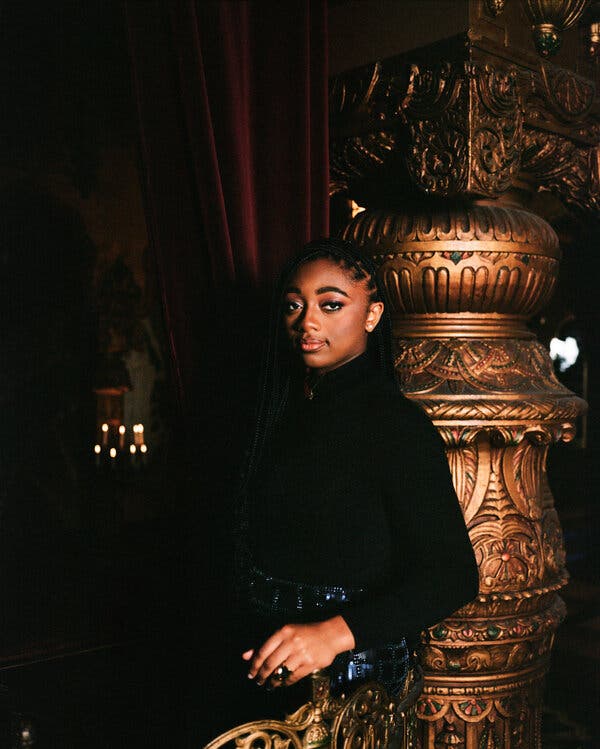
PHOTO: “This is a young music,” Samara Joy said of jazz. “It deserves to be talked about and shared. And as long as I’m passionate about it, that’s my goal — to share it.” Credit: Scott Rossi for The New York Times
by Elysa Gardner December 12, 2022 New York Times
Samara Joy was kicking off an encore engagement at New York’s storied Blue Note club in November, just days before her 23rd birthday, when sparks began to fly.
“It was my first set, and I was in the middle of telling a story,” she recounted a few weeks later. “I was building up this whole scenario that was going to get me into the song, and then I closed my eyes — and when I opened them, five seconds later, there was all this smoke coming up.” (A woman seated by the stage got a bit too close to a flickering candle; the fire was swiftly extinguished.)
“Nothing like that had ever happened to me before,” Joy said, giggling softly. Just a week later, she had another, more traditional first, picking up two Grammy nominations for “Linger Awhile,” her second album and Verve Records debut. The album teams her with noted musicians — the guitarist Pasquale Grasso, the pianist Ben Paterson, the bassist David Wong and the drummer Kenny Washington — on standards including Monk’s “‘Round Midnight” and Gershwin’s “Someone to Watch Over Me.”
Joy, a Bronx native who’s currently based in Washington Heights, goes by her first and middle name (her surname is McLendon). She will compete in February for best jazz vocal album and best new artist — a field in which recent winners have included ubiquitous stars such as Olivia Rodrigo, Megan Thee Stallion and Billie Eilish.
When she got the news, Joy was on a train heading home after a gig in Washington, D.C. “I felt like screaming,” she said, “but I was in the quiet car, so I couldn’t freak out.”
Joy has grown accustomed to reaping honors. In 2019, as a student at the State University of New York at Purchase, she won the Sarah Vaughan International Jazz Vocal Competition; she became an Ella Fitzgerald Memorial Scholar the following year. Joy’s singing, with its precocious depth, creamy tone and fluttery vibrato, continued to inspire comparisons to both of those legends after the release of several videos that went viral, something of a rarity in jazz — in one, she performed Duke Ellington’s “Take Love Easy,” a song recorded by Fitzgerald in the 1970s — and a self-titled album in 2021.
While Joy said she wasn’t especially active on social media at first, it has grown into a natural tool for expression. Jamie Krents, the president of Verve Records, said Joy’s presence there “was one of the things that attracted us to her — seeing how genuine and intriguing she was, and how that could shine through on those channels. She’s a normal 23-year-old person who happens to be a world-class singer.”
Regina King, Anita Baker, Chaka Khan and Don Cheadle have also expressed admiration. The celebrated bassist and composer Christian McBride, who judged Joy in the Sarah Vaughan competition, finds her vocals “full of wisdom.”
“It’s spooky; she sounds and tells a story like an elder,” he said in a phone interview. “But I think what I love most about her — and I pray that the challenges in life don’t change this — is she’s always positive. She’s got such a fun, positive spirit.”
That spirit was palpable during a conversation at a food court in her neighborhood, where Joy admitted her fast success has left her head spinning a bit. “Sometimes I honestly don’t believe this is happening,” she said. “I see pictures of this glammed-up girl, but I’m just me” — on that afternoon, a young woman wearing sensible glasses and no perceptible makeup, clad in sneakers and a down jacket she picked up at Marshalls.
The singer, who is currently touring with the Jazz at Lincoln Center Orchestra in “Big Band Holidays” — the show will arrive at the Rose Theater Wednesday through Sunday — has spent little time at home over the past six or seven months, juggling dates throughout the United States and Europe. “When there are people my age in the crowd, it’s mostly students,” she said. “Or you have younger audience members who have seen me on Instagram or TikTok” — Joy has more than 200,000 followers on the video platform — and tend to be less familiar with jazz.
Joy can empathize: She sang with a jazz band in high school that tended toward “a lot of contemporary, fusion-y stuff,” and was largely unfamiliar with the repertoire until arriving at Purchase. And while she’s the paternal granddaughter of the noted gospel singers and preachers Elder Goldwire and Ruth McLendon, who performed with the Savettes of Philadelphia, that genre also held little appeal initially.
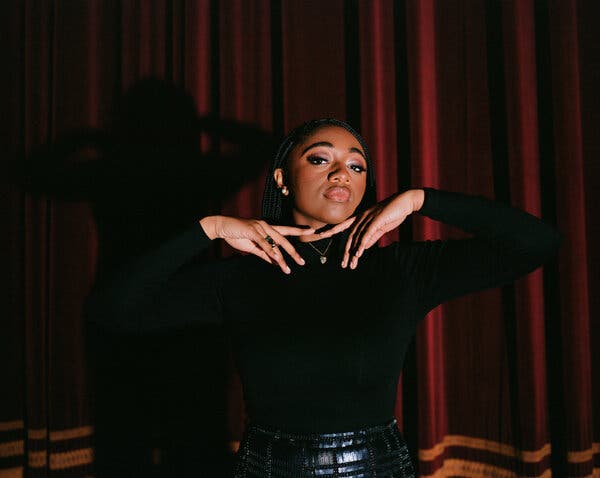
PHOTO: Joy will compete for two Grammys in February, including one in an all-genre category: best new artist. Credit: Scott Rossi for The New York Times
Instead, Joy listened to the old-school R&B beloved by both her parents, “Marvin Gaye and Aretha Franklin and Stevie and Chaka,” she said, and sang in middle and high school musicals, making her theatrical debut as Erzulie (the goddess of love) in a sixth-grade production of “Once on This Island.” “I was scared about the acting part, because I was very shy — I still get that way sometimes,” she said. “But I wanted to sing, so I was like, ‘We’re going to learn these lines and try as best we can to get inside this character.’”
Eventually, Joy did begin singing in church, where her father also performed frequently. (Antonio McLendon is a singer, songwriter and bassist who has toured with the gospel star Andraé Crouch.) “I started in the choir when I was 16, and then I started to sing lead, which was nerve-racking,” she said. “The church live-streamed the services, and I had all these eyes on me.” She nonetheless became “more serious about it, because I was there all the time. We had rehearsal, we had Bible study, we had services on Saturday and Sunday. That was my priority — whereas jazz band was just an after school thing, a couple of songs here and there.”
When Joy won the Sarah Vaughan competition, “My grandfather was disappointed, I think” — Ruth McLendon had died in 2014 — “because he thought singing belonged in the church, that it should serve as worship to God,” she explained. “I don’t think he would ever come into a jazz club, because of his beliefs, which I respect and understand. I know that he still loves me, regardless of how he feels about the career decisions I’m making.”
Joy’s ambitions include writing; she penned rhapsodic lyrics for “Nostalgia (The Day I Knew),” a sweetly breezy number on “Linger Awhile.” “Now I’m paying more attention to the melodies and harmonics of all these songs I’m singing,” she said. “I’m telling this composer’s story and this lyricist’s story, and it’s beautiful, but I hope I can be influenced enough to write content for myself.”
Studying giants like Vaughan and Fitzgerald — Carmen McRae and Betty Carter are also favorites — has also made Joy eager to explore a range of styles: “Sarah Vaughan could sing anything; she could go incredibly deep and then she could sing operatically, and neither seemed like a struggle. I look at her, and at some opera singers, and I want that ease.”
When Joy speaks specifically of jazz, of course, there is a particular sense of devotion. “I look at all these influences — like Charlie Parker, like Duke Ellington, like Betty Carter and Sarah Vaughan — and I think, these people were here,” she said, a measure of awe creeping into her quiet voice. “This is a young music, and they did so much in their lives to draw people to this type of music; it deserves to be talked about and shared. And as long as I’m passionate about it, that’s my goal — to share it.”
Kofi Natambu, editor of and contributor to Sound Projections, is a writer, poet, cultural critic, and political journalist whose poetry, essays, criticism, reviews, and journalism have appeared in many literary magazines, journals, newspapers, and anthologies. He has written extensively about music as a critic and historian for many publications, including the Black Scholar, Downbeat, Solid Ground: A New World Journal, Detroit Metro Times, KONCH, the Panopticon Review,Black Renaissance Noire, the Village Voice, the City Sun (NYC), the Poetry Project Newsletter (NYC), and the African American Review. He is the author of a biography Malcolm X: His Life & Work (Alpha Books) and two books of poetry: The Melody Never Stops (Past Tents Press) and Intervals (Post Aesthetic Press). He was the founder and editor of Solid Ground: A New World Journal, a national quarterly magazine of the arts, culture, and politics and the editor of a literary anthology Nostalgia for the Present (Post Aesthetic Press). Natambu has read his work throughout the country and given many lectures and workshops at academic and arts institutions. He has taught American literature, literary theory and criticism, cultural history and criticism, film studies, political science, creative writing, philosophy, critical theory, and music history and criticism (Jazz, Blues, R&B, Hip Hop) at many universities and colleges. He was also a curator in the Education Department of Detroit’s Museum of African American History. Born in Detroit, Michigan, Natambu currently lives in Berkeley, California with his wife Chuleenan.